 By Tiberius
As data center traffic continues to grow, network operators need optical connectivity that supports higher bandwidth without requiring a complete redesign of their existing infrastructure. Cloud computing, enterprise applications, AI workloads, and large-scale data transfers are increasing the demand for reliable high-speed links between switches, routers, and other network devices. Choosing the right optical transceiver is therefore an important part of network planning, particularly when transmission distance and fiber infrastructure influence deployment costs.
Different 400G optical solutions serve different purposes. Some are designed for short-reach connections within data centers, while others support longer links between network equipment located in separate rooms, buildings, or facilities. Selecting an appropriate transceiver requires evaluating the required reach, optical interface, equipment compatibility, and overall network architecture rather than focusing on bandwidth alone.
For applications requiring 400G Ethernet connectivity over distances of up to 10 km, 400G QSFP-DD modules based on the 400GBASE-LR8 specification can be a suitable option. This transceiver type combines a high-density QSFP-DD form factor with eight-wavelength optical transmission over single-mode fiber. Understanding its characteristics and limitations helps network engineers determine when LR8 is the right choice for a particular deployment.
What Is a 400GBASE-LR8 QSFP-DD Transceiver?
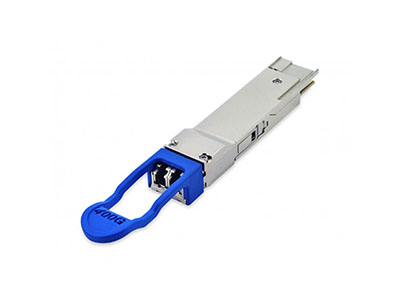
A 400GBASE-LR8 QSFP-DD transceiver is an optical module designed to support 400 Gigabit Ethernet over single-mode fiber, typically with a maximum link reach of 10 km under the specified operating conditions. The LR8 designation refers to a long-reach implementation using eight optical wavelength channels. The QSFP-DD form factor allows the module to fit into compatible high-density switching platforms designed for 400G connectivity.
Unlike copper connections, which transmit electrical signals directly through conductive cables, an optical transceiver converts electrical signals from a host device into optical signals for transmission over fiber. At the receiving end, the module converts incoming light back into electrical signals. This approach supports high-bandwidth communication while offering the reach and electromagnetic immunity associated with optical fiber.
How Does the LR8 Optical Architecture Work?
The LR8 architecture uses eight optical wavelength channels to carry the aggregate 400G data stream. In a typical implementation, each channel operates at approximately 50 Gb/s using PAM4 signaling, with the eight channels combining to deliver an aggregate line rate of 400 Gb/s. The channels operate within the 1310 nm wavelength region, although the exact wavelength grid and channel specifications depend on the applicable standard and module design.
Wavelength-division multiplexing allows multiple optical channels to travel over a shared fiber pair. Within the transceiver, the optical signals are combined for transmission and separated at the receiving end. This arrangement enables a long-reach 400G connection without requiring eight separate transmit and eight separate receive fiber paths. It also makes LR8 different from parallel-optics solutions such as DR4, which use multiple fiber lanes rather than multiple wavelengths on a duplex fiber interface.
When Should You Choose a 400GBASE-LR8 Module?
When Network Links Need to Reach Up to 10 km
One of the main reasons to choose a 400GBASE-LR8 module is the need to connect network devices over distances that exceed the practical reach of many short-reach optical solutions. For example, a large data center campus may have switches in separate buildings, while a service provider may need high-capacity connections between facilities within a metropolitan area. A 10 km-rated optical interface can support these links when the fiber path and optical budget satisfy the module’s specifications.
The specified reach should not be treated as a guarantee that every 10 km installation will work without further evaluation. Fiber attenuation, connector insertion loss, patch panels, splices, and other components contribute to total channel loss. Engineers should verify that the completed link meets the relevant optical requirements before deploying the transceivers in production.
When Existing Infrastructure Uses Single-Mode Fiber
LR8 is also worth considering when a network already relies on single-mode fiber. Single-mode fiber is widely used for longer-distance optical communication because it minimizes modal dispersion and supports a broad range of transmission distances. Reusing suitable existing fiber infrastructure can reduce the need for new cable installation and simplify network upgrades.
However, the connector type and fiber plant must match the specific transceiver. A typical 400GBASE-LR8 QSFP-DD module uses a duplex LC interface, with one fiber carrying transmit traffic and the other carrying receive traffic. The exact connector polish, fiber specification, and compatibility requirements should be confirmed in the module datasheet before installation.
When High Port Density Matters
QSFP-DD is designed to support high-density network equipment, making it attractive for switches and routers that need to accommodate many high-speed interfaces within a limited rack space. Deploying 400G connections through a compatible QSFP-DD platform can increase available bandwidth without requiring every link to occupy a separate, larger form-factor port.
Port density is particularly important in data centers where rack space, switch capacity, and cabling organization affect infrastructure planning. Nevertheless, engineers should consider the host platform’s power and thermal limits, supported transceiver types, and port configuration. A QSFP-DD module should only be installed in equipment that explicitly supports the relevant module specification.
400GBASE-LR8 vs. Other 400G Optical Solutions
Not every 400G network requires an LR8 transceiver. For short-reach connections within a rack or data hall, a solution such as 400GBASE-SR8 may be appropriate when compatible multimode fiber is available. For single-mode links over shorter distances, 400GBASE-DR4 is another option, using parallel optical lanes rather than the wavelength-multiplexed architecture of LR8.
The differences affect more than transmission distance. SR8 generally uses multiple multimode fiber lanes, while DR4 uses parallel single-mode fiber lanes. LR8 uses eight wavelengths over a duplex single-mode fiber connection, which can simplify fiber routing when a duplex link is preferred. The best choice depends on the required reach, available cabling, connector interfaces, optical budget, and cost of the complete link.
Network operators should also check the exact Ethernet standard and interoperability requirements. Transceivers with the same nominal data rate are not necessarily interchangeable, even when their physical form factors appear similar. The host switch, remote transceiver, and optical channel must all support a compatible transmission scheme.
What Should You Check Before Deployment?
Before selecting a 400GBASE-LR8 QSFP-DD module, confirm that the switch or router supports the module type and required operating mode. Compatibility information should cover hardware revision, firmware support, port configuration, and any restrictions imposed by the equipment manufacturer. Digital diagnostics monitoring, when supported, can help track module temperature, supply voltage, and optical transmit and receive power.
The fiber link also requires careful inspection and testing. Verify the single-mode fiber type, connector compatibility, polarity, and total insertion loss. Clean connector end faces using appropriate procedures, and test the installed channel to confirm that its performance falls within the specified limits. These checks help prevent avoidable link failures and simplify troubleshooting after deployment.
Conclusion
A 400GBASE-LR8 QSFP-DD module is a practical choice when a network requires 400G Ethernet connectivity over single-mode fiber at distances of up to 10 km. Its eight-wavelength architecture, duplex fiber interface, and high-density QSFP-DD form factor make it suitable for selected data center interconnects, campus networks, and other long-reach Ethernet applications.
The decision ultimately depends on the link distance, existing fiber infrastructure, switch compatibility, and deployment requirements. By comparing LR8 with alternative 400G optical solutions and validating the complete optical channel, network engineers can select a transceiver that delivers the required bandwidth and reach while making effective use of their existing infrastructure.
 Caleb